
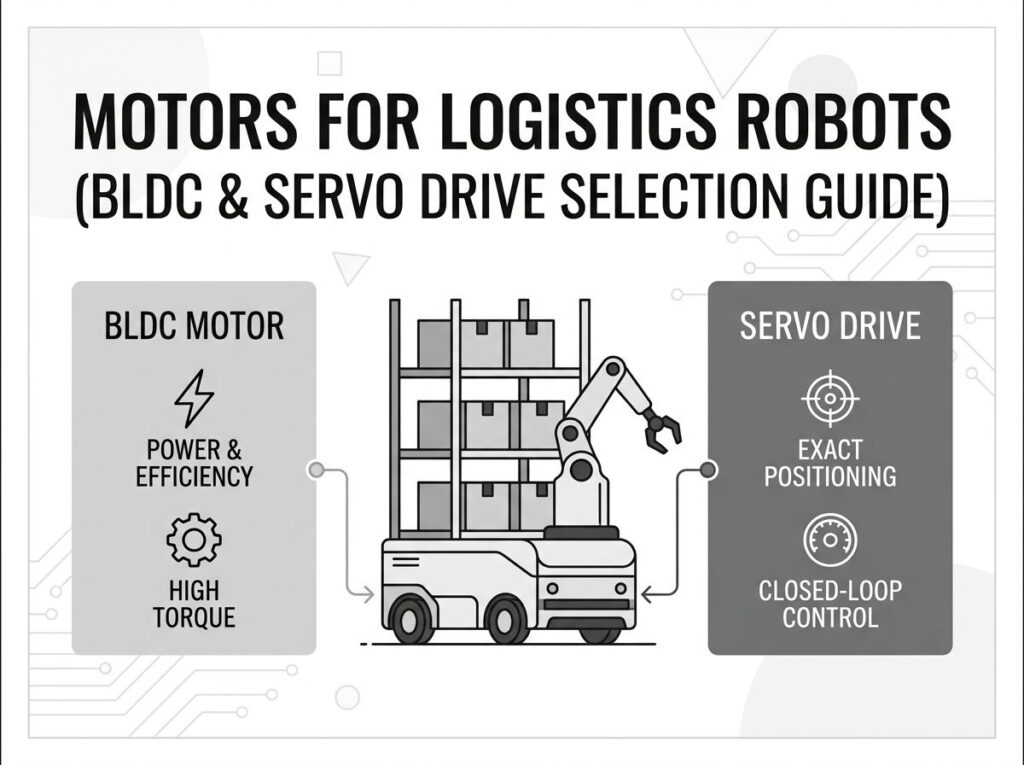
Motors for Logistics Robots: BLDC & Servo Drive Selection Guide
[ez-toc]
What Are Logistics Robots?
A logistics robot is any battery-powered, guided or autonomous machine that moves goods through the supply chain—from inbound receiving and storage, through picking and sortation, to outbound dispatch and even last-mile delivery. “Motors for logistics robots” therefore spans the full traction and actuation assembly: the motor itself, the controller, the gearbox, the encoder/feedback and the brake, all validated as one certified, high-availability system.
The defining difference from adjacent AGV classes is the deployment scale and duty mix. Where a warehouse AGV is optimized for throughput and cost, a manufacturing AGV for line-synced stop-and-go, a hospital robot for silence and EMC, and an airport baggage AGV for 24/7 environmental survival, a logistics robot must serve all of those roles in one fleet—and often in counts of thousands of actuators per site. That changes the motor acceptance criteria from “does it move the load” to “does it move the load efficiently, reliably and at scale.”
How the Logistics Robot Drive System Works
Regardless of payload, every logistics robot shares the same drive chain. Selecting the motor means walking this chain and assigning the right component at each stage:
Step 1 — Battery supplies the bus
A Li-ion or LiFePO₄ pack delivers a nominal bus voltage (24 V for sorter actuators and light AMRs, 48 V for movers and pallet carriers). Because P = V × I, a higher bus voltage means lower current for the same power, reducing cable size and copper loss. A 1 kW sorter bank at 24 V draws ~42 A; at 48 V it draws ~21 A and runs roughly 4× cooler in the harness. See our AGV battery-voltage selection guide for the full derivation, including the SELV boundary that keeps 24 V safe for field servicing.
Step 2 — Controller commutates the motor
For a BLDC motor, the controller switches current from rotor position (Hall sensors for block commutation, or encoder for sinusoidal/FOC). Maxon documents that block commutation shows ~14% torque ripple, while field-oriented control (FOC) delivers about 5% more continuous torque with smoother running—valuable when a sorter actuator or mover starts loaded. Sensorless schemes exist but hesitate at 0 RPM, which is unacceptable for a loaded start (see our Hall vs sensorless comparison).
Step 3 — Gearbox multiplies torque
A planetary gearbox trades speed for torque at 90–95% efficiency. Wheel torque is T_wheel = T_motor × ratio × η_gear. Geared BLDC hub and axle motors (e.g. 48 V, 200 W–3 kW, 2–60 N·m, IP65, encoder, electromagnetic brake) are the workhorses of goods-to-person AMRs and pallet carriers because the reduction and wheel are one sealed, serviceable unit. For sorters, a small BLDC or closed-loop stepper is paired directly with a diverter arm.
Step 4 — Wheel meets the floor (or actuator meets the parcel)
The driven wheel converts motor torque into tractive force; a sorter diverter converts it into a lateral parcel kick. Output torque must exceed roll/grade/acceleration demand with margin, or the AMR stalls on a 3% aisle grade and the sorter misses its slot. This is where the AGV torque calculation turns a payload into a motor spec.
Step 5 — Feedback closes the loop
Encoder + Hall signals let the controller hold speed against a 600 kg load, regenerate on braking, and report temperature/current to the fleet manager. On a logistics line, that telemetry feeds predictive maintenance—a single overheated sorter motor can drop a parcel, so early thermal warnings matter more than in a free-running warehouse. SKF Energy Efficient (E2) bearings cut friction 30–50% and roughly double grease life, directly lifting fleet MTBF.
Motor Topology Comparison
| Topology | Best logistics use | Voltage | Typical power | Feedback | Why / why not |
|---|---|---|---|---|---|
| Geared BLDC (hub/axle) | Goods-to-person AMR, pallet mover, 50 kg–1.5 t | 24–48 V | 200 W–3 kW | Hall + encoder + brake | Best efficiency/cost/maintenance balance for traction; sealed one-piece unit |
| Integrated BLDC servo | SLAM-navigated AMR, heavy pallet, 100 kg–3 t | 48 V | 500 W–5 kW | Encoder (high-res) + brake | Smooth low-speed approach, ±0.5–2 mm docking, payload compensation |
| Closed-loop stepper | Sorter diverter, light lifter, <30 kg actuators | 24 V | 10–100 W | Encoder (hybrid) | Zero step loss at high frequency start/stop; cheap at thousand-unit scale |
| Multi-axis AC/BLDC servo | Heavy lift, AS/RS stacker, 1–10 t | 48–72 V | 1–10 kW | Absolute encoder + brake | Sub-mm precision, 300% overload for ramp start, thermal stability |
| Brushless frameless (flat) | In-wheel / in-joint compact integration | 24–48 V | 30–600 W | Hall + NTC | Highest torque density, hollow shaft for cabling; needs custom mechanical integration |
| Brushed DC | Not recommended for fleets | 24 V | — | — | Brush replacement cost > savings at multi-shift scale; standardize on BLDC |
Engineering Data: Duty, Efficiency, Torque
Insulation classes and thermal limits (IEC 60034-1)
| Insulation class | Max winding temp | Logistics use |
|---|---|---|
| Class B | 130 °C | Light, well-cooled sorter actuators |
| Class F | 155 °C | Standard for AMR traction in 40 °C warehouses |
| Class H | 180 °C | Hot sortation halls, sealed outdoor last-mile bots |
Ambient derating matters: a motor rated 60 °C ambient at Class F loses roughly 10–15% of continuous torque at 50 °C and another step at 60 °C. For 24/7 fulfilment in non-climate-controlled hubs, specify Class H or add forced cooling.
Efficiency and IE class
| Motor type | Efficiency range | IE equivalent |
|---|---|---|
| Standard BLDC (geared) | 85–92% | — |
| IE3 servo-grade BLDC | 90–93% | IE3 |
| IE4 premium (e.g. Siemens SIMOTICS SD) | 93–96% | IE4 |
| Yaskawa Sigma-7 servo (heat-reduced design) | ~20% less heat vs prior gen | IE4-class |
For battery logistics fleets, every efficiency point compounds across thousands of charge cycles. The AGV motor efficiency and battery-runtime guide shows how a 3-point efficiency gain extends per-charge runtime by double digits.
Core torque and force formulas
The tractive force a logistics robot must develop is:
F = m·g·Crr + m·g·sinθ + m·a
where m is gross mass, g ≈ 9.81 m/s², Crr the rolling resistance (~0.02 on smooth concrete), θ the floor grade, and a target acceleration. Wheel torque is then T_wheel = F × r, and the motor torque required is:
T_motor = (T_wheel) / (ratio × η_gear)
Worked example — 500 kg goods-to-person AMR: at 3% grade, 0.5 m/s² acceleration, r = 0.1 m → F ≈ 495 N, T_wheel ≈ 24.8 N·m across two wheels (≈12.4 N·m each). With a 20:1 planetary at 90%: T_motor ≈ 0.69 N·m each; add a 1.5× safety factor → ~1.4 N·m continuous, so specify a 48 V BLDC servo rated ~3 N·m (≈3000 RPM, 20:1). Always size for RMS torque over the real cycle, not the peak.
IEC 60034-1 duty cycles for logistics robots
| IEC class | Profile | Typical logistics use | Derating note |
|---|---|---|---|
| S1 | Continuous, steady state | Conveyor-style mover, 24/7 line | None — rated = continuous |
| S3 | Intermittent periodic, no start influence | Goods-to-person AMR pick-and-place (40% on-time) | Size to cyclic duration factor |
| S4 | Intermittent with starting | Frequent start/stop AMR at workstations | Starting current heats winding; derate by RMS |
| S5 | Intermittent with braking | AMR with frequent regen braking | Braking energy must be dissipated/recovered |
| S6 | Continuous periodic (load/no-load) | Cross-belt / wheel sorter running continuously | Never cools fully; size to cyclic factor |
Manufacturer benchmark data
| Manufacturer | Model / family | Key specs | Logistics relevance |
|---|---|---|---|
| Maxon | IDX 70 + EPOS4 | 750 W, IP65, 3.46 N·m cont / 7.27 N·m peak, integrated temp sensor | Tough continuous logistics duty; EC frameless kits for in-wheel use |
| FAULHABER | BP4 / BX4 / BXT | 12–48 V, up to 158 mNm (BP4), 134 mNm (BXT), 91% η, −40 to +125 °C | Dynamic start-stop automation, compact sorter actuators |
| Yaskawa | Sigma-7 | 24-bit encoder, 350% overload, 3.1 kHz bandwidth, STO SIL3, ~20% heat cut | Integrated-servo reference for high-reliability lines |
| Siemens | SIMOTICS SD IE4 | IE4 efficiency, high power density | Energy-saving fleet option |
| SKF | E2 energy-efficient bearing | 30–50% lower friction vs standard | Extends bearing life ~2×, lifts fleet MTBF |
Best Applications by Robot Type
| Logistics robot | Payload | Recommended topology | Voltage | IEC duty | Notes |
|---|---|---|---|---|---|
| Goods-to-person AMR | 50–200 kg | Geared BLDC hub | 24–48 V | S3 / S4 | High dynamic response, frequent dock/undock |
| Pallet / unit-load AGV | 0.5–1.5 t | BLDC servo | 48 V | S3 / S4 | ±2 mm docking, payload compensation |
| Tugger / chain-tow | 1–10 t | Geared BLDC / servo | 48–72 V | S1 / S3 | Multi-cart trains, long hauls |
| Cross-belt / tilt-tray sorter | per-parcel actuator | Small BLDC / closed-loop stepper | 24 V | S6 | 1,000–10,000 units on one bus |
| Last-mile delivery robot | 20–100 kg | Geared BLDC | 24–48 V | S1 / S3 | IP65+, −20 to +55 °C outdoor range |
| AS/RS stacker crane | 0.2–2 t lift | BLDC servo + brake | 48 V | S4 / S5 | Safe vertical lift, holds load on power loss |
How to Select a Logistics Motor
- Define the robot class and payload. Goods-to-person, pallet, tugger, sorter or last-mile each implies a different topology and duty.
- Calculate required force. Use
F = m·g·Crr + m·g·sinθ + m·aat your worst-case grade and acceleration; convert to wheel then motor torque. - Pick the bus voltage. 24 V for light AMRs and sorter actuators, 48 V for movers and pallet carriers, 72 V for heavy tuggers. Match motor rating to battery nominal.
- Select the duty class. Map the real cycle to IEC S1/S3/S4/S5/S6 and size for RMS torque, not peak. Check ambient derating for your hub temperature.
- Choose the gearbox ratio. Target 1,500–3,000 RPM motor speed at cruise; 20:1 is typical for a 500 kg AMR. Keep inertia ratio J_load/J_rotor ≤ 5:1 (servo) to 15:1 (BLDC).
- Specify feedback and brake. Encoder resolution from your docking accuracy; electromagnetic brake for any slope, park or e-stop. Confirm efficiency and compliance.
- Target IE3 minimum, IE4 preferred. Verify IEC 60034-1 and (for US) DOE alignment; for EU note EU 2019/1781 / (for US) the 2027 IE4 expansion. Run a 5-year TCO compare.
- Validate at fleet scale. For sorters, size the shared bus for aggregate inrush, demand zero step loss (S6) and require a documented fleet MTBF plus CANopen/EtherCAT telemetry for predictive maintenance.
Common Engineering Mistakes
| Mistake | Consequence | Correct approach |
|---|---|---|
| Sizing on peak, not RMS torque | Thermal trip / winding burnout in S3/S4 duty | Size to RMS over full cycle + ambient derating |
| Choosing stepper for >100 kg traction | Step loss, stalled vehicle | Use BLDC or servo with closed-loop feedback |
| Ignoring inertia matching | Oscillation, tuning difficulty | Keep J_load/J_rotor ≤ 5:1 (servo) to 15:1 (BLDC) |
| Skipping IP rating | Bearing contamination, winding corrosion | IP54 min indoor; IP65 for field/last-mile; IP66+ wash-down |
| No brake on slope applications | Roll-away on e-stop | Specify 24 V electromagnetic power-off brake |
| 24 V motor on 48 V bus (or vice-versa) | Half speed / overvoltage fault | Match motor rating to battery nominal voltage |
| No regen path on S5/S6 duty | Overvoltage trip on braking | Add regen circuit / dissipation resistor |
Troubleshooting Table
| Problem | Likely cause | Solution |
|---|---|---|
| Motor overheats in service | RMS torque > continuous rating; high ambient | Derate, upsize, or improve cooling; Class F/H |
| Position drift at dock | Low encoder resolution; belt slip | Increase PPR / use absolute encoder; tighten coupling |
| Step loss / stall | Open-loop stepper under sudden load | Switch to closed-loop stepper or BLDC servo |
| Wheel slip on launch | Insufficient starting torque | Higher ratio or Design C/D start torque |
| Excess acoustic noise | Spur gear whine; resonance | Use helical planetary; damp mounting |
| Battery drains fast | Low motor/gear efficiency | Move to IE4 BLDC + 92%+ planetary; reduce losses |
| Controller overvoltage on brake | No regen path (S5/S6) | Add regen resistor / bidirectional drive |
| Cannot hold on slope at rest | No brake or brake failed | Add/verify 24 V electromagnetic brake |
| Premature bearing failure | Contamination; wrong lube | Raise IP rating; use SKF E2 low-friction bearing |
FAQ
What type of motor is used in logistics robots?
Most logistics robots use brushless DC (BLDC) motors with Hall sensors for traction, paired with a planetary gearbox, encoder and electromagnetic brake; integrated servo motors are used where precise docking or heavy lift is required. Goods-to-person AMRs (50–200 kg) and pallet carriers (0.5–1.5 t) run geared BLDC hub/servo motors (24/48 V, 200 W–3 kW, 2–60 N·m). Cross-belt and tilt-tray sorters deploy thousands of small BLDC or closed-loop stepper actuators (24 V) behind a shared bus. Last-mile outdoor bots add IP65+ sealing and a wider −20 to +55 °C range. Sensorless control is avoided on traction because it hesitates under a loaded start.
How is a logistics robot motor different from a warehouse AGV motor?
The hardware is largely the same BLDC/servo family, but the acceptance criteria diverge. A warehouse AGV is tuned for throughput and cost; a logistics robot must also serve the full chain—high dynamic response for sortation (millisecond start/stop), high efficiency for battery life across multi-shift fleets, and the ability to be deployed in huge distributed counts (one sorter can carry 1,000–10,000 actuators). That pushes duty matching to IEC 60034-1 S3/S4 for movers and S6 for continuously running sorters, plus a documented fleet MTBF because one failed motor in a thousand-unit sorter can stall a parcel line.
How many motors run in a logistics sortation system, and how are they powered?
A single cross-belt or wheel sorter routinely carries 1,000–10,000 independent diverter drives, each a small BLDC or closed-loop stepper that must start, stop and reverse in milliseconds. They are fed from a shared 24 V DC bus through distributed CANopen or EtherCAT drivers, so the main controller can dispatch thousands of units in real time. Because no single point of failure can stop the line, each motor is specified for S6 continuous-periodic duty with zero step loss, and the bus is sized for the aggregate inrush current, not just the steady-state sum.
How do I size a motor for a 500 kg goods-to-person AMR?
Start from force: F = m·g·Crr + m·g·sinθ + m·a for a 500 kg gross mass on a 3% floor grade at 0.5 m/s² acceleration → about 495 N total, or ~25 N·m at the wheel (r = 0.1 m) split across two driven wheels. With a 20:1 planetary at 90% efficiency, the motor needs ~1.4 N·m continuous per wheel; add a 1.5× safety factor and you land near a 48 V, ~3 N·m-rated BLDC servo per wheel (≈3000 RPM, 20:1). Size for RMS torque over the real cycle, not the peak, and confirm IEC S3 duty with the ambient-derated rating.
Is 24 V or 48 V better for logistics robots?
For logistics robots the bus is mostly 48 V, and 24 V only on light goods-to-person AMRs and the thousands of sorter actuators. Because P = V × I, a higher bus cuts current for the same power and shrinks copper loss (I²R). A 1 kW sorter bank at 24 V draws ~42 A; at 48 V it draws ~21 A and runs ~4× cooler in the harness. 24 V remains standard for small distributed sorters because the per-unit power is low and the bus must stay within the SELV envelope for safe field servicing—see our battery-voltage selection guide for the derivation.
Which manufacturers publish logistics-grade BLDC/servo motor data?
Maxon documents the IDX 70 drive system (750 W, IP65, up to 3.46 N·m continuous / 7.27 N·m peak, EPOS4 controller, integrated temperature sensor) built for tough continuous logistics duty, and EC frameless kits for in-wheel integration. FAULHABER’s BP4 (12–48 V, up to 158 mNm, 91% efficiency, −40 to +125 °C) and BX4/BXT lines target dynamic start-stop automation and compact sorter actuators. Yaskawa’s Sigma-7 servo (24-bit encoder, 350% overload, 3.1 kHz bandwidth, STO SIL3, ~20% heat reduction) is the integrated-servo reference for high-reliability logistics lines. Siemens SIMOTICS SD IE4 and SKF E2 energy-efficient bearings round out a high-MTBF drivetrain.
Why Choose GreenSky for Logistics Robot Motors?
GreenSky Power designs and manufactures the full BLDC and integrated-servo drivetrain behind warehouse, sortation and last-mile logistics robots—motors, planetary gearboxes, encoders, brakes and matching controllers validated as one system. Our 24/48 V platforms are built to IEC 60034-1 duty (S1/S3/S4/S6), rated Class F/H for 24/7 fulfilment hubs, and delivered with the CANopen/EtherCAT telemetry logistics fleets need for predictive maintenance. Whether you are scaling a goods-to-person AMR or deploying a 5,000-actuator sorter, our engineering team turns your payload, duty cycle and bus voltage into a defensible motor specification—backed by IE3/IE4 efficiency and documented fleet MTBF. Talk to our application engineers about your logistics robot program →
References
- IEC 60034-1:2022 — Rotating electrical machines, Part 1: Rating and performance (duty types S1–S10, thermal limits). webstore.iec.ch/publication/69035
- IEC 60034-30-1:2014 — Efficiency classes of line-operated AC motors (IE1–IE5). webstore.iec.ch/publication/67931
- NEMA MG 1-2021 — Motors and Generators (Table 12-12 NEMA Premium = IE3; §12.58 efficiency tolerance). nema.org/standards/view/mg-1-motors-and-generators
- U.S. DOE 10 CFR Part 431 — Energy efficiency program for commercial/industrial equipment (electric motors). ecfr.gov/current/title-10/chapter-II/subchapter-D/part-431
- Liu, Zhong, Willcock, Fisher & Shi (2023). “An Open Approach to Energy-Efficient Autonomous Mobile Robots,” IEEE ICRA 2023 — up to 44.8% energy reduction via coordinated control. par.nsf.gov/biblio/10487735
- Yang, Peng, Hu, Li & Xie (2025). “Internal-Stably Energy-Saving Cooperative Control of Articulated Wheeled Robot with Distributed Drive Units,” IEEE ICRA 2025. doi.org/10.1109/ICRA55743.2025.11128843
- Maxon EC frameless brushless DC motor technology brief (block vs sinusoidal/FOC commutation, Hall sensors, NTC). maxongroup.com EC frameless PDF
- FAULHABER brushless DC motors technical information (BX4/BP4/BXT, 4-pole ironless winding, efficiency data). faulhaber.com brushless DC PDF
- Yaskawa Sigma-7 servo systems catalog (24-bit encoder, 350% overload, STO SIL3, ~20% heat reduction). yaskawa.com Sigma-7 brochure
- Siemens SIMOTICS SD IE4 motors — high-efficiency drives for logistics and material handling. siemens.com SIMOTICS
