

What Are Motor Brushes?
Quick Answer
Motor brushes are stationary, spring-loaded blocks of conductive material — usually carbon or graphite composite — that press against the rotating commutator (or slip rings) to carry current between the fixed power supply and the spinning armature. In a brushed DC or universal motor they are the component that performs commutation: they reverse current direction in each armature coil at the right moment so the rotor keeps turning one way. Carbon is used because it is conductive, self-lubricating, and soft enough to wear away instead of the expensive copper commutator. When brushes wear out, the motor loses power, sparks, or stops — making them the single most common replaceable wear part in brushed motors.
Contents
- What Are Motor Brushes?
- How Motor Brushes Work: The Commutation Cycle
- Brush Material Types Compared
- Engineering Data: Brush Pressure, Drop, Wear & Life
- Where Motor Brushes Are Used
- Selection Guide: How to Choose the Right Brush
- Common Engineering Mistakes With Motor Brushes
- Motor Brush Troubleshooting Table (Problem → Cause → Solution)
- Why Choose Greensky for Brushed & Brushless Motion
- Frequently Asked Questions
What Are Motor Brushes?
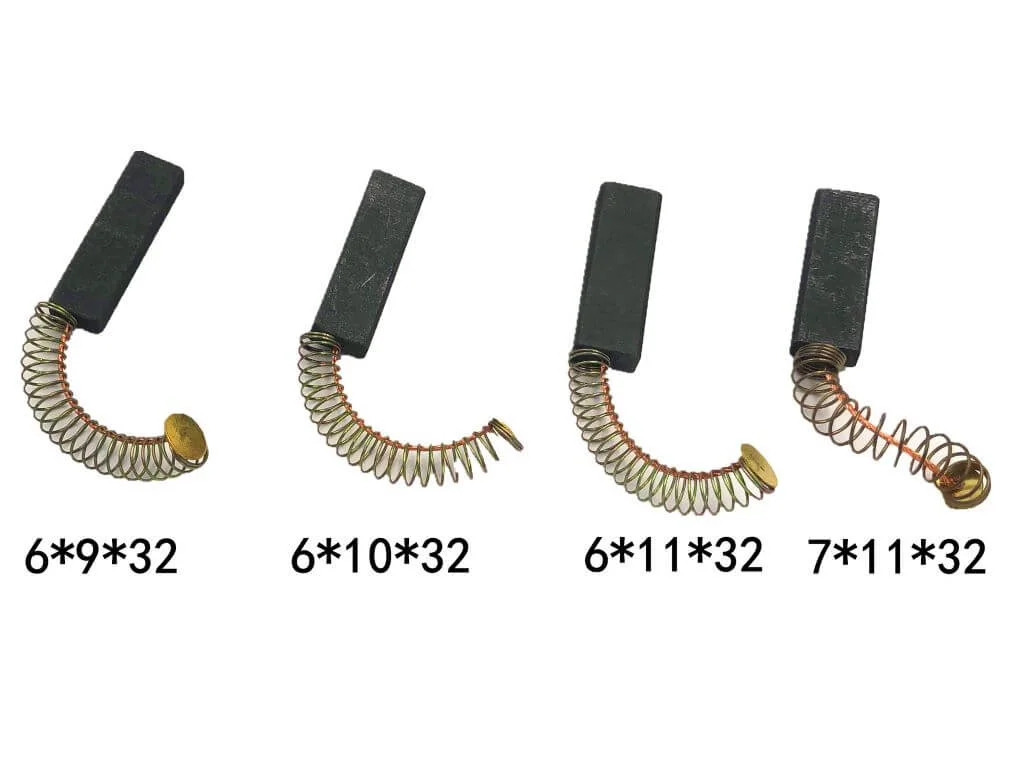
A motor brush is a sliding electrical contact. A rotating shaft cannot be hard-wired to a stationary circuit — any rigid wire would twist and snap the moment the shaft turns. The brush solves this with a controlled sliding interface: a block held in a brush holder presses against a rotating conductive surface, maintaining continuous electrical contact through friction rather than a fixed joint.
In a brushed DC or universal motor that rotating surface is a commutator — a cylinder of copper segments separated by insulating mica. In AC wound-rotor machines and generators the surface is a slip ring (a continuous ring, no switching). The brush’s job is identical in both: move current across the moving boundary without breaking the circuit.
Why Carbon, Not Metal?
The choice of carbon/graphite is a deliberate engineering compromise between conflicting needs:>
| Requirement | Why carbon/graphite wins |
|---|---|
| Electrical conductivity | Carbon composites conduct enough current while keeping contact resistance high enough to limit arcing |
| Sacrificial wear | Soft graphite wears preferentially, protecting the hard, expensive copper commutator |
| Self-lubrication | Graphite’s layered crystal structure slides with very low friction and deposits a protective film |
| Thermal stability | Carbon stays stable where copper would soften, deform, or weld to the contact |
| Film formation | A “patina” (copper oxide + graphite) builds on the commutator, lowering friction and noise over time |

How Motor Brushes Work: The Commutation Cycle
Follow the current and you can see exactly what the brush does in each rotation:
- DC is applied to the brush terminals. Current enters through the positive brush.
- Current crosses the sliding contact into the commutator segment touching that brush, then into the connected armature coil.
- The energized coil becomes an electromagnet and the Lorentz force (F = B·I·L) pushes it against the stator field, producing torque.
- The rotor turns, carrying the commutator with it. A few degrees before the coil would reach the “dead” aligned position (zero torque), the brush crosses to the next segment.
- Current reverses in that coil and feeds the next optimally-placed coil — so torque always acts in the same rotational direction.
- The cycle repeats dozens to thousands of times per second, giving smooth, continuous rotation.
With many coils (a typical motor has 9–24, large machines over 100 commutator segments), torque ripple stays small. Manufacturers such as maxon even use an odd number of commutator bars so only one brush commutates at a time — this reduces torque ripple and the energy switched per step, cutting brush fire and EMI.
Three Actions Happen at Once
>
| Action | How | Failure if absent |
|---|---|---|
| Spring pressure | 150–400 g/cm² (≈15–30 kPa) keeps the brush on the commutator | Bouncing → arcing, intermittent power |
| Current conduction | Carbon carries current across the sliding gap with low loss | Open circuit → motor stops |
| Controlled wear | Soft graphite conforms to the surface and wears slowly | Commutator scoring, rapid failure |
For the failure modes this wear produces, see our guide on why brushed motors spark, and for the brushless alternative read BLDC motor disadvantages.
Brush Material Types Compared
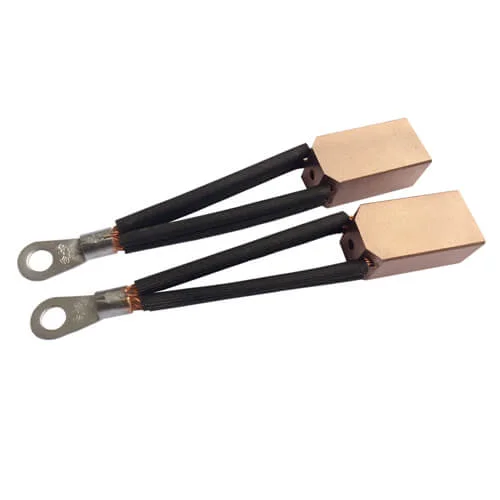
Brush “grade” is the carbon-graphite matrix tuned with additives (copper, silver, resins) for the motor’s voltage, current, speed, and environment. Using the wrong grade causes premature wear or commutator damage.>
| Brush type | Composition | Contact resistance | Best application |
|---|---|---|---|
| Pure carbon | Carbon | High | Low current density, small DC motors |
| Graphite | Natural graphite | Medium | Lubrication-critical, general purpose |
| Carbon-graphite | Carbon + graphite | Medium–high | Balanced; power tools, industrial equipment |
| Electrographitic | Heat-treated carbon-graphite | Medium | Power tools, traction, high-speed motors |
| Metal-graphite (copper) | Graphite + copper | Very low | High current, low voltage, heavy industrial |
| Metal-graphite (silver) | Graphite + silver | Very low | Precision, high current density |
| Precious metal | Bronze body + silver-plated tip | Extremely low (~50 mΩ) | Small motors, low current, battery (maxon EB) |
Graphite vs Precious-Metal Brushes (maxon)
On small DC motors, OEMs choose between two fundamentally different commutation systems. maxon’s technical notes summarize the trade:>
| Property | Graphite brushes (GB) | Precious-metal brushes (EB) |
|---|---|---|
| Contact body | ~50% graphite + 50% copper | Spring-bronze with silver-plated tip |
| Commutator | Copper alloy | Silver alloy |
| Contact resistance | Higher | Extremely low (~50 mΩ) |
| No-load current / friction | Higher (more drag) | Very low |
| Current capability | High; tolerates start/stop & current peaks | Low; damaged by high current / brush fire |
| EMI | Commutation spikes | Low (uniform pattern); CLL further suppresses |
| Typical use | Larger motors, reversing, PWM, servo | Small motors, continuous, battery, tachometers |
Precious-metal brushes gain life through CLL (capacitor long-life) technology: an RC filter across adjacent segments damps the inductive arc at commutation, reducing electro-erosion and EMI.
Engineering Data: Brush Pressure, Drop, Wear & Life
These are the numbers a maintenance or design engineer actually uses. Ranges reflect typical small-to-industrial brushed motors.>
| Parameter | Typical value | Note / source |
|---|---|---|
| Brush contact pressure | 15–30 kPa (≈150–400 g/cm²) | Too low → bounce/arc; too high → rapid wear |
| Contact voltage drop | 0.5–2 V per brush set | Loss that never reaches the armature |
| Current density (carbon) | ~10 A/cm² typical | Metal-graphite runs higher |
| Wear rate | 0.01–0.1 mm per hour | Allows planned replacement |
| Brush service life | 500–5,000 hours | High current = short; light load = long |
| Precious-metal contact R | ~50 mΩ | maxon EB commutator |
| Commutator bars | Odd number | Reduces torque ripple & brush fire (maxon) |
Sparking Acceptance Limits (IEC 60034-1)
IEC 60034-1 defines four commutation sparking grades. A service tech should never accept Class 3; Class 2 is only permissible under the overload conditions stated on the nameplate.>
| Class | Description | Acceptable? |
|---|---|---|
| 1 | No sparking; commutator and brushes unchanged | Ideal at all loads |
| 1½ | Faint sparking at brush edges only | Permissible continuously |
| 2 | Permissible under stated overload conditions | Allowed, but investigate |
| 3 | Dangerous sparking, fire/erosion risk | Never acceptable |
What the Research Says About Brush Wear
- Electrical vs mechanical wear: A City University of Hong Kong study on sliding contacts (brush load 50–800 gf, speed 1,000–35,000 rpm, current 0–20 A) found brush wear is electrical (arc erosion) at low load and mechanical at high load — so both under- and over-springing accelerate failure (Louie, CityU HK thesis, 2007).
- Sparking mechanism: Current reversal during commutation dissipates stored winding energy at the brush edge, raising local current density and igniting arcs that drive electro-erosion (Tribology International, commutator wear, 2002).
- Arc vs sliding wear: In automotive fuel-pump DC motors, short commutation arcs produced mostly mechanical sliding wear, but longer arcs caused arc erosion — a wear model separates the two regimes (IEICE Trans. Electronics, 2010).
- Tribolayer failure: One of two identical motors failed at 1,200 h (the other ran 1,500 h) because a thick oxide/carbon layer built up on the commutator and brush — confirming that a healthy commutator film is essential to life (Surface & Coatings Technology / Tribology, 2015).
Where Motor Brushes Are Used
Brushed motors remain the default wherever low cost, simple control, and high starting torque matter more than maintenance-free life.>
| Application | Why brushes fit | Brush concern |
|---|---|---|
| Power tools (drills, grinders) | High starting torque, cheap, repairable | High current → frequent brush changes |
| Household appliances | Low cost, simple drive | Quiet, low-spark grade |
| Automotive (starters, alternators, seats) | Robust, high inrush tolerance | Vibration, temperature |
| Traction & industrial | High current density (metal-graphite) | Commutator maintenance |
| Generators & wind turbines | Slip-ring current transfer | Continuous duty wear |
| Aerospace / specialized | Electrographitic at altitude | Extreme environment grade |
Robotic and precision actuators often skip brushes entirely for gear-reduced BLDC instead; our piece on why robotic arms need speed reducers covers that trade-off.
Selection Guide: How to Choose the Right Brush
- Match the current and voltage: high current / low voltage → metal-graphite (copper); low current / battery → precious-metal; general purpose → carbon-graphite or electrographitic.
- Match the duty: start/stop, reversing, or PWM drives need graphite brushes; continuous low-current running suits precious-metal (with CLL).
- Set spring pressure to spec: target 15–30 kPa. Never guess — pressure is calibrated to brush grade and speed.
- Verify commutator condition: a grooved or out-of-round commutator destroys even the correct brush. Re-surface before fitting new brushes.
- Confirm dimensions & grade code: brush size, lead style, and the manufacturer’s grade marking must match the original.
- Replace as a set with springs: always fit new pressure springs together with the brushes so pressure stays correct.
Common Engineering Mistakes With Motor Brushes
>
| Mistake | Why it hurts |
|---|---|
| Wrong brush grade | Premature wear, commutator scoring, or excessive sparking |
| Wrong spring pressure | Too low → bounce/arc; too high → mechanical wear & heat |
| Using emery cloth on the commutator | Copper grit embeds between bars, worsens sparking — use a commutator stone |
| Ignoring mica undercut | Carbon builds on the mica, bridges segments, drives sparking |
| Replacing brushes but not springs | Old springs lose tension → low pressure → arcing |
| Mixing brush types in one motor | Uneven wear and current sharing → hot spots |
| Skipping commutator resurfacing | New brushes wear to a bad profile in hours |
Motor Brush Troubleshooting Table (Problem → Cause → Solution)
>
| Problem | Likely Cause | Solution |
|---|---|---|
| Excessive sparking | Worn brush, wrong grade, grooved commutator, low spring pressure | Replace brush to spec; resurface commutator; set pressure |
| Rapid brush wear | Too much pressure, abrasive dust, wrong grade, high current | Reset pressure; clean environment; fit correct grade |
| Motor weak / low speed | Brushes worn short, poor contact, oxidized commutator | Replace brushes; clean/seat commutator; check film |
| Overheating at brushes | High pressure, overduty current, arcing | Reduce load; correct pressure; verify grade |
| Grinding / rough running | Commutator out of round, embedded grit | Re-machine or replace commutator; resurface |
| Intermittent power | Bouncing brush, loose lead, worn spring | Seat brush; tighten lead; replace spring |
| Motor will not start | Brushes gone, open lead, seized bearing | Fit new brush set; check circuit; free shaft |
For the full diagnostic sequence (including winding and insulation tests), use our DC motor troubleshooting guide.
Why Choose Greensky for Brushed & Brushless Motion
When a brushed motor reaches end-of-brush-life — or when your design wants to skip brushes altogether — Greensky supplies both paths from one source, built to IEC 60034 and NEMA MG 1 dimensions so they drop into existing mounts:
- Brushed PMDC & universal motors with documented commutator specs, brush-grade options, and replacement-brush programs for maintenance teams.
- Brushless (BLDC) motors and gear motors with matched Hall sensors and drives — eliminating brush wear, sparking, and commutation maintenance entirely.
- Integrated gear motors that multiply torque at the output shaft, reducing the current (and brush stress) the motor core must handle — see our gearbox vs gear motor guide.
- Flange compatibility: IEC B5/B14 and NEMA C-face with customized pilot diameters — see our motor flange guide.
- Low-MOQ OEM/ODM: small batches for spares programs and custom shaft/encoder configurations.
Related Reading
- What Is a DC Motor? Types, Principle & Formulas
- Why Do Brushed Motors Spark? Causes & Fixes
- How to Troubleshoot a DC Motor: Step-by-Step Guide
- BLDC Motor Disadvantages Engineers Should Know
- How to Short a DC Motor (Short-Circuit Braking)
- What Is a Motor Flange? IEC vs NEMA Mounting
- AC vs DC Motor: Which to Choose
- Gearbox vs Gear Motor: Differences & Selection
- Synchronous vs Induction Motor: Key Differences
- Why Robotic Arms Need Speed Reducers
References
- IEC 60034-1 — Rotating Electrical Machines: Rating and Performance (sparking classes, temperature limits). webstore.iec.ch/publication/67467
- IEC 60034-30-1 — Efficiency Classes for Rotating Electrical Machines (IE1–IE5). webstore.iec.ch/publication/67784
- NEMA MG 1 — Motors and Generators (safety, thermal, mounting dimensions). nema.org/standards/view/mg-1-motors-and-generators
- IEEE 43-2013 — Recommended Practice for Insulation Resistance Testing of Rotating Machinery. standards.ieee.org/ieee/43/4385
- IEEE 112 — Standard Test Procedure for Polyphase Induction & DC Motors (loss & back-EMF methods). standards.ieee.org/ieee/112/4213
- U.S. DOE — Electric Motor Efficiency Determination & Repair Guidance. energy.gov/eere/amo/articles/determination-electric-motors
- SKF — Bearing maintenance and lubrication for electric motors. skf.com/us/products/maintenance-products/bearing-maintenance
- maxon — Brushed DC motor commutation: graphite vs precious-metal brushes, CLL. maxongroup.com/medias/sys_master/8798093410334.pdf
- FAULHABER — DC-Motors Technical Information (precious-metal commutation). faulhaber.com/en/technical-information
- Louie, Y.T. (CityU HK, 2007) — Tribological characteristics of brush/commutator sliding contact (PV factors, wear regimes). scholars.cityu.edu.hk/en/theses/theses(e7add903-b2e5-4635-9695-c59f031b68d6).html
Frequently Asked Questions
What are motor brushes made of
Most are a carbon-graphite composite. Grades range from pure carbon and natural graphite through carbon-graphite and electrographitic, to metal-graphite (copper or silver) for high current, and precious-metal (silver-plated bronze) for small low-current motors. The mix is tuned to the motor’s voltage, current, speed, and environment.
What is the difference between graphite and precious-metal brushes?
Graphite brushes (~50% graphite + 50% copper) handle high current and start/stop peaks but add friction and commutation spikes. Precious-metal brushes have extremely low contact resistance (~50 mΩ), very low friction, and low EMI, but are limited to small, low-current, continuous-duty motors — and are protected from arc damage by CLL capacitor technology.
How long do motor brushes last?
Typically 500 to 5,000 operating hours. High-current power-tool motors sit at the short end; lightly loaded small motors at the long end. Wear runs about 0.01–0.1 mm per hour, which is why brushes are designed as planned-replacement wear parts.
What brush pressure should be used?
Usually 15–30 kPa (about 150–400 g/cm²), calibrated to the brush grade and motor speed. Too little pressure lets the brush bounce and arc; too much causes rapid mechanical wear and overheating. Always replace the pressure springs with the brushes.
Is brush sparking normal?
A faint spark at the brush edges (IEC 60034-1 Class 1 or 1½) is acceptable. Dangerous sparking (Class 3) is never acceptable and signals worn brushes, a grooved commutator, wrong grade, or incorrect spring pressure that must be corrected before continued operation.
Can a motor run without brushes?
Only if it is brushless. Brushed DC, universal, AC wound-rotor, and generator designs all need brushes or slip rings to transfer current across the rotating boundary. Brushless DC (BLDC) replaces the mechanical contact with electronic commutation — see our BLDC overview for the trade-offs.
