
Why Do Power Tools Generally Use Brushed Motors?
What “Brushed Motor” Means in a Power Tool
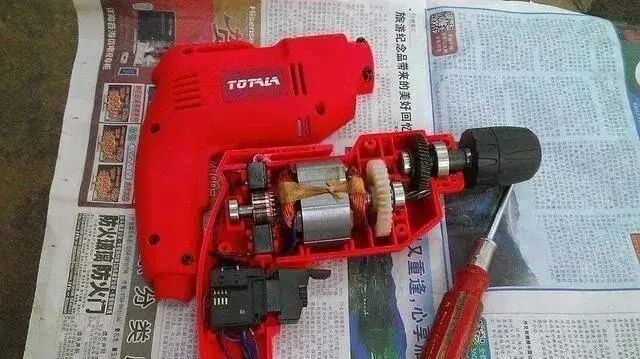
When an engineer says a power tool “uses a brushed motor,” they almost always mean a universal motor — a series-wound DC motor that, thanks to its commutator and carbon brushes, also runs on single-phase AC. (Cordless tools sometimes use a permanent-magnet DC, PMDC, motor, which is also brushed.) The brushes are spring-loaded carbon blocks that press on a spinning copper commutator, reversing current in each armature coil so torque always acts in one direction.
The alternative is a brushless DC (BLDC) motor, where the commutator is replaced by an electronic controller and fixed stator coils. No brushes means no sparking, no brush wear — but it means a circuit board, sensors, and firmware that a brushed tool simply does not have.

DC brush motor principle
As shown in Figure 1, this is a DC brush motor structure model. Two fixed anisotropic magnets, placed in the middle of a coil, the ends of the coil were connected to two semicircular copper ring, copper ring ends and fixed carbon brush contact, and then to the carbon brush ends were connected to the DC power supply.
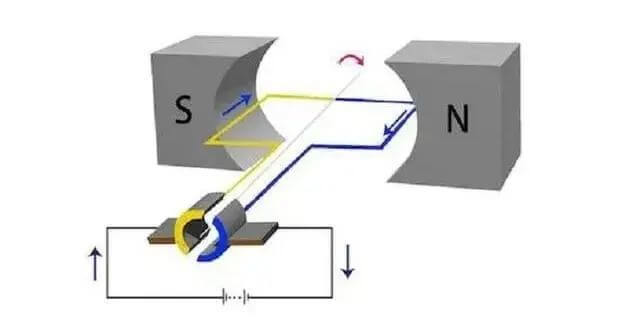
Figure 1
After the power supply is connected, the current is as shown by the arrow in Figure 1. According to the left-hand rule, the yellow coil is subjected to a vertical upward electromagnetic force; the blue coil is subjected to a vertical downward electromagnetic force. The motor rotor starts to rotate clockwise and after 90 degrees of rotation, as shown in Figure 2.
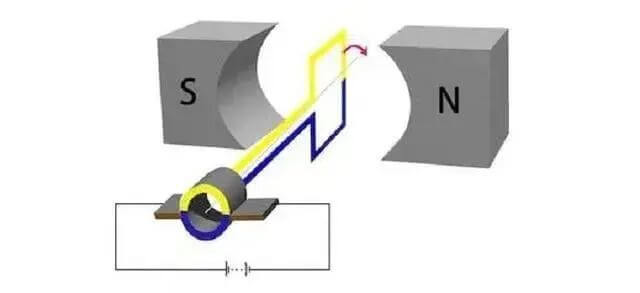
Figure 2
At this time, the carbon brush is just in the middle of the gap between the two copper rings, and there is no current in the whole coil circuit. But under the action of inertia, the rotor still continues to rotate.
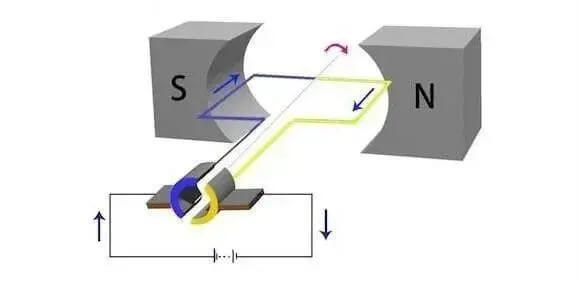
Figure 3
When the rotor turns to the above position under inertia, the coil current is shown in Figure 3. According to the left-hand rule, the blue coil is subjected to a vertical upward electromagnetic force; the yellow coil is subjected to a vertical downward electromagnetic force. The motor rotor continues to rotate clockwise, after 90 degrees, as shown in Figure 4: at this time, the carbon brush is just in the middle gap between the two copper rings, and there is no current in the whole coil circuit. But under the action of inertia, the rotor still continues to rotate. Then the above steps are repeated, and the cycle continues.
Brushless DC Motor
As shown in Figure 5, this is a model diagram of a DC brushless motor structure. It consists of a stator and a rotor, where the rotor has a pair of magnetic poles; the stator is wound with many sets of coils, six sets of coils are shown in the diagram.
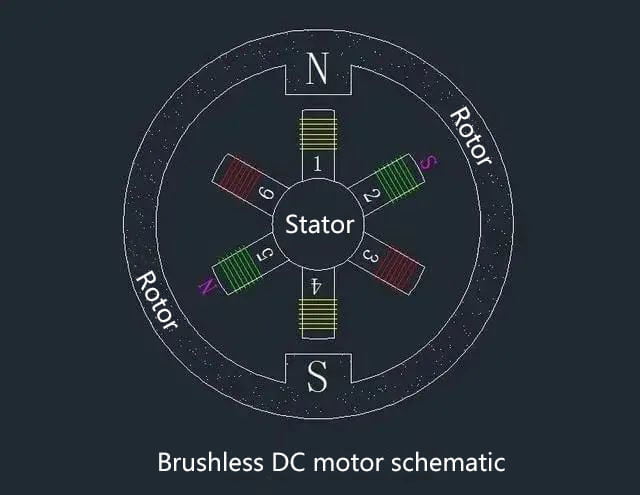
Figure 5
When we pass current to the stator coils 2 and 5, the coils 2 and 5 will produce a magnetic field, and the stator is equivalent to a bar magnet, where 2 is the S (south) pole and 5 is the N (north) pole. Since the same-sex poles attract each other, the rotor N pole will rotate to the coil 2 position and the rotor S pole will rotate to the coil 5 position, Figure 6.
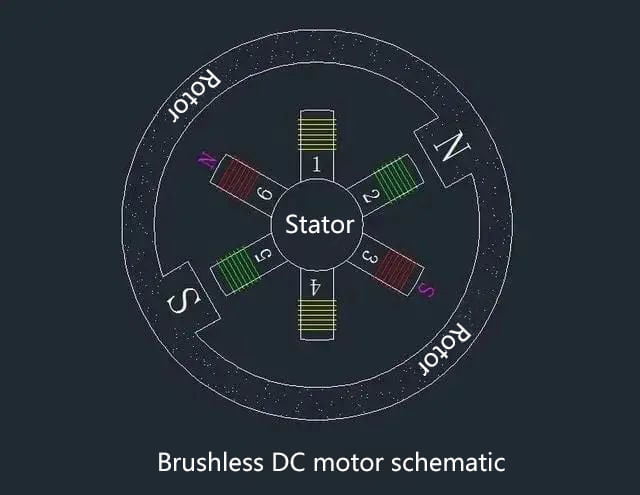
Figure 6
Then we withdraw the current from the stator coils 2 and 5 and pass current to the stator coils 3 and 6. At this time, coils 3 and 6 will produce a magnetic field, and the stator is equivalent to a bar magnet, where 3 is the S (south) pole and 6 is the N (north) pole. Since same-sex magnetic poles attract each other, the rotor N pole will rotate to the coil 3 position and the rotor S pole will rotate to the coil 6 position, Figure 7.
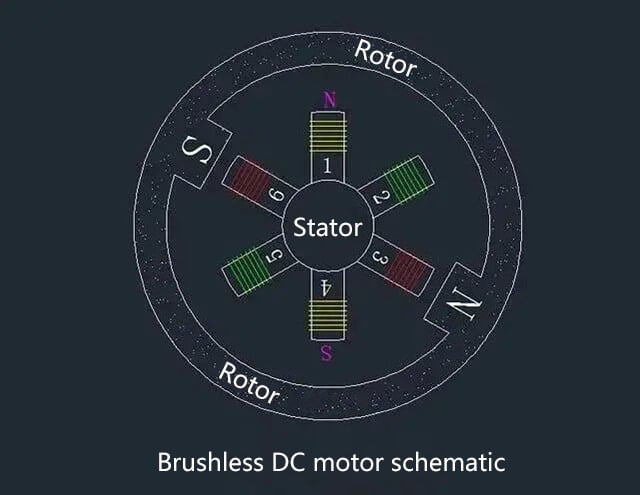
Figure 7
Similarly, then remove the current from the stator coils 3 and 6, and then pass the current to the stator coils 4 and 1. At this time, coils 4 and 1 will produce a magnetic field, and the stator is equivalent to a bar magnet, where 4 is the S (south) pole and 1 is the N (north) pole. Since the opposite poles attract each other, the rotor N pole will rotate to the coil 4 position and the rotor S pole will rotate to the coil 1 position. Up to
Up to this point, the motor has rotated half a turn …. The second half turn is the same as the previous principle, so we will not repeat it here. We can simply understand the DC brushless motor as like fishing a carrot in front of a donkey, so that the donkey will keep moving towards the carrot.

So how can we pass the exact current to different coils at different moments? This requires a current commutation circuit …… I won’t go into detail here.
Brush DC motor and brushless DC motor advantages and disadvantages comparison
DC brush motor: fast starting, timely braking, smooth speed regulation, simple control, simple structure, cheap. The point is that the price is cheap! The price is cheap! The price is cheap! And it has high starting current, high torque (rotating force) at low speed, and can carry very heavy load.
However, because of the friction between carbon brush and commutator, DC brush motor is easy to produce sparks, heat, noise, electromagnetic interference to the external environment, and low efficiency and short life. Because the carbon brush is a wear and tear product, it is easy to fail, and needs to be replaced after a period of time.

DC brushless motor: because the DC brushless motor eliminates the carbon brush, so the noise is small, no maintenance, low failure rate, long service life, and the running time and voltage is more stable, for the radio equipment interference to be small. But it is expensive! Expensive! Expensive!
Power tools are very common tools in life, and there are many different brands and fierce competition, so people are very sensitive to the price. And power tools it needs to need to carry a very heavy load, must be a lot of starting torque, such as hand drill, impact drill. Otherwise, when drilling, the motor can easily not run because the drill bit is stuck.

Imagine a brush DC motor with low price, high starting torque and able to carry heavy load; brushless motor has low failure rate and long life, but it is expensive and the starting torque is far less than brush motor. If you choose, how will you choose, I think the answer is self-explanatory.
Brushed vs Brushless — The Core Difference
| Aspect | Brushed (universal / PMDC) | Brushless (BLDC) |
|---|---|---|
| Commutation | Mechanical — brushes + commutator | Electronic — controller + Hall sensors |
| Control electronics | None (switch + triac for AC speed) | Required driver PCB + firmware |
| Starting torque | Very high (stall current = V/Rₐ) | High, but limited by controller current cap |
| Power source | AC or DC (universal) | DC only (or via rectifier) |
| Fragile parts | None electronic — robust in dust/heat | Controller sensitive to moisture/ESD/spikes |
| Maintenance | Replace brushes (wear part) | Virtually maintenance-free |
| Upfront cost | Low — 30–50% cheaper | Premium (20–50% more) |
How a Brushed (Universal) Motor Produces High Starting Torque
The reason brushed motors dominated drills, grinders, and saws comes down to one physics fact about the series-wound design. Walk through it:
- The field and armature are in series. Field current equals armature current, so at high current the magnetic field is also at its strongest.
- At standstill, back-EMF is zero. The induced voltage E = kₑ·ω is proportional to speed ω; when ω = 0, E = 0.
- Current is only limited by winding resistance. I = (V − E)/Rₐ = V/Rₐ, which is huge because Rₐ is small (fractions of an ohm).
- Torque surges. T = kₜ·Iₐ, so the stall current produces a large stall torque — for a series (universal) motor, torque scales roughly with the square of current (T ∝ I²).
- As it spins up, back-EMF rises and current falls to a steady operating value — the motor self-regulates to the load.
- The commutator keeps it one-way. Brushes switch current direction in each coil at the right instant, so torque never cancels out.
This is exactly why a drill doesn’t stall when the bit binds in hardwood: the motor pulls a massive inrush current and converts it directly into torque. An IEEE analytical study of universal motors confirms they remain in use for “drills and saws” precisely because of their “wide variable-speed range, high starting torque, low cost and attractive power/weight ratio” (IEEE Xplore, 5994773).
The Starting-Current Reality (Worked Example)
Real brushed motors exploit this inrush rather than fight it. Measured on a maxon RE 30 brushed DC motor at 24 V (EDN, brushed DC motor current):
| Condition | Current | Power | Note |
|---|---|---|---|
| Spin-up peak (≈1 ms) | 29 A | ≈700 W | Brief inrush to overcome inertia |
| Stall (rotor held) | 34 A | 816 W | Maximum torque condition |
| Continuous running | 2 A | 48 W | Rated operating point |
| Max allowed continuous | 3.5 A | 84 W | Thermal limit to avoid damage |
A brushless controller must cap this inrush with closed-loop current limiting; a brushed tool simply lets the copper and magnets handle it. maxon itself notes brushed DC motors “can be operated without external electronics… a useful alternative to BLDC motors,” with torque control “implemented using the current” and “low start-up voltage even after a long period in standstill” (maxon DCX program).
Brushed vs Brushless Power Tools — Quantitative Comparison
The reason the market has shifted (but not fully) is visible in the numbers. Ranges reflect typical consumer-to-professional corded and cordless tools.
| Parameter | Brushed (universal) | Brushless (BLDC) | Source / note |
|---|---|---|---|
| Efficiency | 50–60% (cheap universal); 70–85% (good PMDC) | 85–90%+ | BLDC loses less to friction/heat |
| Upfront cost | Baseline | +20–50% premium | PowerToolLab, KitD data |
| Battery runtime (same pack) | Baseline | +30–50% more holes/charge | PowerToolLab drill test (276 vs 397 holes) |
| Brush / maintenance life | 500–2,000 h (consumer grinder 50–100 h) | Much longer (no wear part) | Duty-cycle dependent |
| Starting torque | Very high; self-limited only by Rₐ | High; capped by controller | T = k·Iₐ vs current limit |
| Speed range | 10,000–20,000+ RPM (geared down) | Wide, EC-controlled | Universalmotor high-speed design |
| Environmental robustness | Excellent (no electronics to fry) | Good, but controller vulnerable | Dust/heat/moisture sensitivity |
Why the Cost Gap Exists
| Component | Brushed | Brushless |
|---|---|---|
| Motor windings | Standard, high-volume | Standard |
| Commutation | Commutator + carbon brushes (~$2) | None |
| Controller | None (switch + triac) | PCB + MOSFETs + firmware |
| Sensors | None | Hall sensors (or sensorless algo) |
| Manufacturing complexity | Low | High (SMT, calibration) |
A 2020 deep-slot universal-motor study for power tools (Northwestern Polytechnical University & China’s National Engineering Research Center for Small & Precision Motors) even optimized the slot design specifically “to reduce the cost of universal motor materials and improve production efficiency” (Springer JoPE, 2020) — cost is engineered in at the source.
Engineering Data: Efficiency, Temperature & Life Limits
These are the numbers a design or procurement engineer actually uses when choosing motor architecture.
| Parameter | Typical value | Standard / note |
|---|---|---|
| Brushed universal efficiency | 50–60% (cheap); up to ~75% loaded | Small universal motors lower at light load |
| Brushed PMDC efficiency | 70–85% | maxon RE series reaches ~90% |
| BLDC efficiency | 85–90%+ | UL / manufacturer lab data |
| Brushless cost premium | +20–50% | Controller + sensors drive it |
| Brush service life | 500–2,000 h (grinder 50–100 h) | High current shortens life |
| No-load speed (universal) | 10,000–20,000+ RPM | Gear-reduced to tool output |
| Commutator temp class | Class B 130 °C / F 155 °C | IEC 60034-1 limits |
| Stall current | V / Rₐ (10–30× running) | EDN maxon RE30: 34 A stall @24 V |
Key Formulas
| Quantity | Formula | Meaning for tool design |
|---|---|---|
| Back-EMF | E = kₑ · ω | Zero at standstill → max current at start |
| Torque | T = kₜ · Iₐ | Torque tracks armature current |
| Stall current | I_stall = V / Rₐ | Bounded only by winding resistance |
| Series-motor torque | T ∝ I² (approx.) | Universal motor: torque rises with current² |
| Speed (loaded) | N ∝ V / (k · Φ), inversely with load | Drops under load; no-load can overspeed |
Sparking Acceptance (IEC 60034-1)
The commutator sparks — that is normal, but only to a limit. IEC 60034-1 defines four sparking grades; a service tech should never accept Class 3.
| Class | Description | Acceptable? |
|---|---|---|
| 1 | No sparking; commutator and brushes unchanged | Ideal at all loads |
| 1½ | Faint sparking at brush edges only | Permissible continuously |
| 2 | Permissible under stated overload | Allowed, but investigate |
| 3 | Dangerous sparking, fire/erosion risk | Never acceptable |
Best Applications for Brushed Power Tools
Brushed motors remain the right call wherever low cost, simple control, high starting torque, or rough-environment robustness outrank maintenance-free life.
| Application | Why brushed fits | Watch-out |
|---|---|---|
| Corded drills / impact drivers (budget) | Cheap, huge starting torque, AC line power | Brush wear over heavy use |
| Angle grinders | Universal motor spins 10k+ RPM natively | High current → short brush life |
| Corded saws / sanders | No battery runtime concern; robust | Commutator maintenance |
| DIY / homeowner tools | Low upfront cost, occasional use | Long idle → brush seat-in needed |
| Dusty / hot job sites | No fragile controller to fry | Vent ingress accelerates wear |
| Repair-focused fleets | Brushes are a cheap field-replaceable part | Spares inventory required |
When the application needs precise, low-maintenance motion instead, brushless or gear-reduced BLDC is the better fit — see our guide on why robotic arms need speed reducers.
Selection Guide: When to Choose a Brushed Motor
- Budget is the priority: if upfront cost dominates (DIY, give-away kits, high-volume OEM), brushed wins by 20–50%.
- The tool is corded or AC-powered: a universal motor runs straight off the line — no battery, no inverter.
- You need stall-grade starting torque: drills, mixers, and augers that bind under load benefit from the V/Rₐ inrush.
- AC/DC flexibility matters: job-site generators or engine-driven welders can be DC; universal motors handle both.
- The environment is harsh: dust, moisture, heat, and voltage spikes destroy controllers faster than they wear brushes.
- Field repair is expected: if operators swap brushes themselves, brushed keeps the tool out of the shop.
- Choose brushless instead when: cordless runtime, tool life, and low noise are worth the premium (professional daily use).
Common Engineering Mistakes With Brushed Power-Tool Motors
| Mistake | Why it hurts |
|---|---|
| Assuming “brushed = obsolete” | Misses the cost, torque, and robustness cases where brushed is still optimal |
| Ignoring brush life in the duty cycle | Consumer grinder brushes wear in 50–100 h; spares must be planned |
| Undersizing the supply for stall current | Stall pulls 10–30× running current; weak supplies brown out |
| Wrong brush grade for the load | High-current tools need electrographitic/metal-graphite, not pure carbon |
| Forgetting the IEC sparking limit | Class 3 sparking erodes commutator and is a fire risk |
| Overlooking AC/DC requirement | A PMDC won’t run on AC; a universal will — verify the source |
Brushed Power-Tool Motor Troubleshooting (Problem → Cause → Solution)
| Problem | Likely Cause | Solution |
|---|---|---|
| Weak / low torque under load | Worn brushes, poor commutator contact, low supply | Replace brush set; clean/seat commutator; check voltage |
| Excessive sparking | Worn brush, wrong grade, grooved commutator | Fit correct grade; resurface commutator; set spring pressure |
| Motor runs hot | Overload, arcing, blocked vents, high ambient | Reduce load; clear vents; verify duty vs IEC class |
| Rapid brush wear | Too much spring pressure, abrasive dust, high current | Reset pressure; clean environment; correct grade |
| No start / intermittent | Brushes gone, loose lead, seized bearing | New brush set; tighten lead; free shaft |
| Burns out on stall | Held stalled beyond thermal limit (I = V/Rₐ) | Add current limit / thermal cutoff; don’t bind the bit |
For the full diagnostic sequence — including winding resistance and insulation tests — use our DC motor troubleshooting guide.
Frequently Asked Questions
Why do power tools use brushed motors instead of brushless?
Brushed (mostly universal) motors are 20–50% cheaper because they need no controller, sensors, or firmware, and they deliver very high starting torque by exploiting the stall inrush (I = V/Rₐ). They also run on AC or DC and survive dust and heat without fragile electronics. Brushless wins on battery life and longevity, but brushed stays best for budget, corded, and repairable tools.
Do brushed power tools have more torque than brushless?
At the instant of starting or binding, a brushed series motor can pull a larger current spike (only limited by winding resistance), so its peak starting torque is very high. Brushless motors are capped by their controller’s current limit, though they hold torque more consistently under sustained load and run more efficiently overall.
Are brushed power tools still good?
Yes — for corded tools, budget DIY use, harsh environments, and fleets that field-replace brushes, brushed motors are a perfectly good, cost-effective choice. For professional cordless daily use where runtime and tool life dominate, brushless is the better long-term investment.
Why are brushed motors cheaper?
They replace an entire electronic control system with a commutator and two carbon brushes. No PCB, no MOSFETs, no Hall sensors, no firmware calibration — just a switch (and a triac for AC speed control). High-volume winding and stamping keep per-unit cost low.
Can a brushed motor run on AC and DC?
A universal motor can — that is its defining feature and why it suits power tools plugged into any outlet or driven by a DC job-site source. A permanent-magnet DC (PMDC) brushed motor runs on DC only unless externally rectified.
How long do power-tool motor brushes last?
Typically 500–2,000 operating hours depending on current and duty; consumer-grade angle-grinder brushes can wear in as little as 50–100 hours under heavy use. Because brushes are a planned-replacement wear part, they are designed to be swapped cheaply rather than ending the tool’s life.
Why Choose Greensky for Brushed & Brushless Motion
Whether your tool design stays with brushed simplicity or moves to brushless efficiency, Greensky supplies both from one source, built to IEC 60034 and NEMA MG 1 dimensions so they drop into existing mounts:
- Brushed PMDC & universal motors with documented commutator specs, selectable brush grades, and replacement-brush programs for maintenance teams.
- Brushless (BLDC) motors and gear motors with matched Hall sensors and drives — eliminating brush wear, sparking, and commutation maintenance for cordless platforms.
- Integrated gear motors that multiply output torque, reducing the current (and brush stress) the motor core must handle — see our gearbox vs gear motor guide.
- Flange compatibility: IEC B5/B14 and NEMA C-face with customized pilot diameters — see our motor flange guide.
- Low-MOQ OEM/ODM: small batches for spares programs and custom shaft/encoder configurations.
Related Reading
- What Is a DC Motor? Types, Principle & Formulas
- What Are Motor Brushes? Types & How They Work
- Why Do Brushed Motors Spark? Causes & Fixes
- What Causes a DC Motor to Lose Torque?
- How to Troubleshoot a DC Motor: Step-by-Step Guide
- BLDC Motor Disadvantages Engineers Should Know
- How to Short a DC Motor (Short-Circuit Braking)
- AC vs DC Motor: Which to Choose
- What Is a Motor Flange? IEC vs NEMA Mounting
- Gearbox vs Gear Motor: Differences & Selection
References
- IEC 60034-1 — Rotating Electrical Machines: Rating and Performance (temperature & sparking classes). webstore.iec.ch/publication/67467
- IEC 60034-30-1 — Efficiency Classes for Rotating Electrical Machines (IE1–IE5). webstore.iec.ch/publication/67784
- NEMA MG 1 — Motors and Generators (safety, thermal, mounting dimensions). nema.org/standards/view/mg-1-motors-and-generators
- IEEE 112 — Standard Test Procedure for Polyphase Induction & DC Motors (efficiency/loss methods). standards.ieee.org/ieee/112/4213
- IEEE Xplore — Analytical model and parameter computation for universal motors (high starting torque, low cost). ieeexplore.ieee.org/document/5994773
- Qi, H. et al. (2020) — Design and research of deep slot universal motor for electric power tools. Journal of Power Electronics, Springer. DOI: 10.1007/s43236-020-00131-6
- maxon — Brushed DC motors (DCX program): operable without external electronics, current-based torque control. maxonmotor.com/dcx-program
- FAULHABER — DC-Motors Technical Information (brushed commutation, precious-metal brushes). faulhaber.com/en/technical-information
- U.S. DOE — Electric Motor Efficiency Determination & Repair Guidance. energy.gov/eere/amo/articles/determination-electric-motors
- SKF — Electric motor maintenance and bearing lubrication. skf.com/us/products/maintenance-products/bearing-maintenance
