
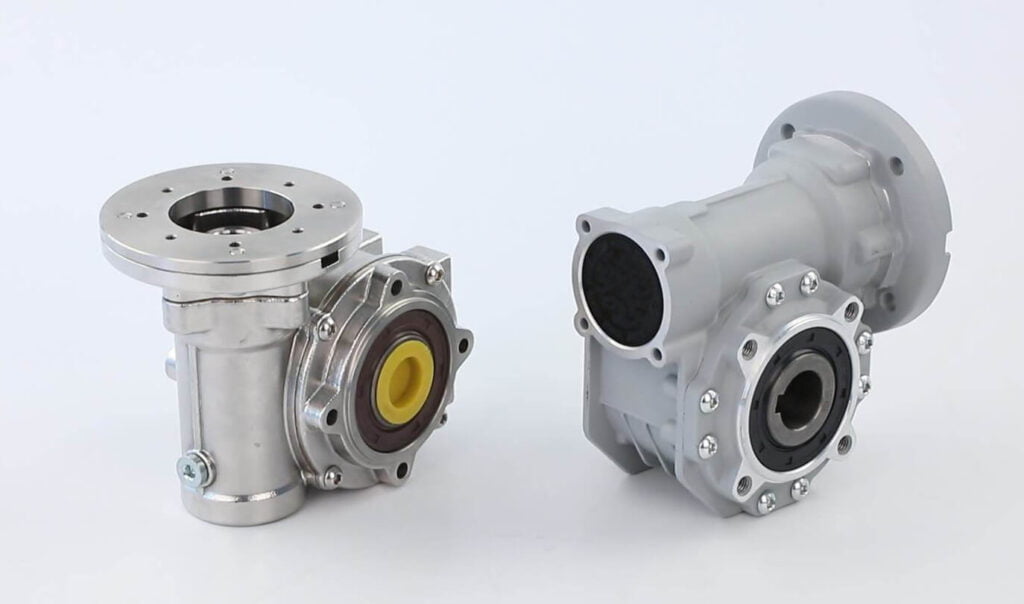
Micro Motor Gear Reducer Common Problems and Solutions
[ez-toc]
What Is a Micro Motor Gear Reducer?
A micro motor gear reducer (micro gearmotor) is a small gearhead coupled to a micro DC, brushless, or AC motor to convert high speed / low torque into low speed / high torque at the output shaft. The gearhead is the part that fails most often, so “gear reducer problems” almost always means gearbox problems, not motor problems. For the motor side of the pair, see our guide on what a DC motor is.
Gearhead Types and Their Failure Tendencies
| Gearhead type | How it works | Typical failure tendency |
|---|---|---|
| Spur (正齿轮) | Pinion on motor shaft drives alternating small/large gears, one contact point per stage | Very high efficiency & low noise; wear shows as gradual backlash growth |
| Planetary (行星) | Planet gears orbit a central sun gear inside an internal ring | Compact, high torque, multi-contact; overload shears teeth or brinells bearings |
| Zero-backlash spur | Preloaded by rotating gear trains opposite, then bracing on the pinion | Best positioning; preload adds friction/heat if misapplied |
FAULHABER’s small gearheads span 3–44 mm diameter and ratios from 3:1 to 983,447:1, all supplied with lifetime lubrication (no relubrication needed) (FAULHABER precision gearheads). That matters below: most “lubrication failure” cases come from using the wrong external grease or running far outside the rated envelope, not from the factory fill.
How a Micro Gear Reducer Works (and Where It Fails)
- The motor spins fast (often 3,000–20,000 rpm for micro units).
- Each gear stage divides speed by its tooth ratio and multiplies torque by roughly the same factor (minus efficiency loss).
- Output torque = motor torque × total ratio × cumulative stage efficiency. A 4-stage planetary at ~60% combined efficiency loses 40% of the multiplied torque to friction.
- The lubricant carries the contact load between gear teeth as an elastohydrodynamic (EHL) film. If that film is too thin, metal asperities touch, and micropitting starts.
- Side loads are borne by the output bearing — not the gears. Exceed its radial/axial limit and the bearing (not the teeth) fails first.
This chain explains why “lost torque” and “noise” are usually downstream symptoms of lubrication or load problems, not of the motor.
Spur vs Planetary Gearhead: Problem Profiles Compared
| Criterion | Spur gearhead | Planetary gearhead |
|---|---|---|
| Max efficiency (per stage) | Very high (~90%) | High (~90% stage 1, dropping with stages) |
| Noise | Low | Low–moderate (more mesh points) |
| Torque density | Lower | Higher (multi-contact) |
| Typical failure mode | Backlash growth, tooth tip wear | Tooth shear under overload, bearing brinelling |
| Best for | Light load, quiet, high efficiency | High torque, compact, robotics |
| Backlash | Standard or zero-backlash option | ≤3° typical (≤1° reduced) |
Pick the wrong type and you pre-load the failure: a spur box on a high-side-load robotic joint will wear its bearing; a planetary box run dry at high torque will shear teeth. See our gearbox vs gear motor guide for the system view.
Engineering Data: Backlash, Load Limits & Lubrication
These are the numbers that separate a real failure analysis from guesswork. Ranges reflect typical micro gearheads (FAULHABER 06/1 planetary and maxon GPX 16 LZ datasheets).
| Parameter | Typical value | Failure threshold / note |
|---|---|---|
| Backlash (no-load) | ≤3° (standard), ≤1° (reduced) | Beyond spec → positioning error, impact wear |
| Per-stage efficiency | ~90% → 48% over 6 stages | More stages = more torque loss |
| Max radial load (output) | ≤5 N (sintered) to 70 N (ball) | Exceed → bearing brinelling, shaft break |
| Max axial load | ≤3 N (ball) to 20 N (maxon GPX) | Exceed → thrust bearing failure |
| Max input speed | 8,000–16,000 min⁻¹ | Above → lubricant breakdown, heat |
| Operating temperature | −30 to +100 °C (some −40) | Beyond → grease hardening / melt |
| Continuous torque | 25–450 mNm (by size) | Exceed → tooth/shear, bearing overload |
The Micropitting Math (Why Lubrication Fails)
Gear-tooth surface failure is governed by the lambda ratio (λ) — the specific lubricant film thickness divided by the combined surface roughness (per AGMA 925 and ISO/TS 6336-22):
- λ > 3 → full film lubrication, negligible wear (tribological run-in only).
- 1 < λ < 3 → mixed lubrication, risk of micropitting grows.
- λ < 1 → asperity contact, micropitting (Hertzian fatigue) and scoring.
Micropitting is driven by cyclic contact stress plus sliding traction on the flank; research confirms it initiates at the pinion dedendum and escalates at the addendum under excessive load and poor film thickness (Wear, 2015, micropitting study). Wear depth along the profile follows Archard’s wear law (V ∝ (load × sliding distance) / hardness) (Springer, micropitting prediction). Practical takeaway: choose lubricant viscosity for your load/speed so λ stays > 3, and never “top up” with an incompatible grease.
Temperature Limits
| Class | Max winding/gear temp | Note |
|---|---|---|
| IEC Class B | 130 °C | General micro gearmotors |
| IEC Class F | 155 °C | Inverter/continuous duty |
| Gearbox lube limit | ~+100 °C | Above → grease softening, leakage, film collapse |
Where Micro Gear Reducers Are Used (and Stressed)
| Application | Gearhead choice | Top failure risk |
|---|---|---|
| Robotics / AGV joints | Planetary, zero-backlash | Backlash growth, side-load on bearing |
| Medical pumps / lab | Spur, low-noise | Contamination from wrong lube |
| Smart locks / actuators | Spur, precious-metal commutation | Stall overload, tooth wear |
| Camera / optic focus | Zero-backlash spur | Preload friction, heat |
| Power-tool attachments | Planetary | Overload shear, bearing heat |
| Conveyor / valve | Planetary or worm | Radial load from belt/pulley |
Note how often the failure risk is load or environment, not the gearbox itself — which is why selection matters as much as maintenance. Our robotic-arm speed reducer article covers the torque-multiplication logic.
Selection Guide: How to Avoid Gear Reducer Problems
- Define output torque & speed: T_out = T_motor × ratio × η_total. Add a 20–30% margin over peak load.
- Check radial/axial load: the belt, pulley, or coupling side-load must stay under the output bearing limit (e.g. ≤5 N sintered, ≤70 N ball). Use an external bearing for higher loads.
- Pick gearhead type: spur for quiet/efficient/light; planetary for torque-dense; zero-backlash for positioning.
- Verify input speed & temperature: keep motor rpm under the gearhead’s max input speed and ambient + rise under the lube limit.
- Confirm lubrication: use the manufacturer-filled lube; if relubrication is needed, use only the specified grade and interval.
- Design the mount: align output shaft to load within 0.1 mm concentricity; never press a pulley onto the output shaft — use a coupling.
- Size the motor too: a weak motor forced to stall stresses both motor and gearhead — see why DC motors lose torque.
Common Engineering Mistakes With Micro Gear Reducers
| Mistake | Why it hurts |
|---|---|
| Press-fitting a pulley onto output shaft | Exceeds press-fit force → bends shaft, brinells bearing, breaks input |
| Exceeding radial load limit | Bearing fatigue → noise, then seizure; often mistaken for “gear failure” |
| Topping up with wrong grease | Incompatible thickener → film collapse → micropitting |
| Running beyond max input speed | Lubricant churns/breaks down → heat → leakage |
| Ignoring backlash growth | Positioning drift, impact loading, accelerated tooth wear |
| Undersizing torque margin | Repeated overload shears teeth or welds bearing |
| Misalignment at coupling | Side-load + vibration → premature bearing and seal failure |
Micro Gear Reducer Troubleshooting Table (Problem → Cause → Solution)
| Problem | Likely Cause | Solution |
|---|---|---|
| Excessive noise / grinding | Worn gears, dry/contaminated lube, bearing damage, misalignment | Inspect teeth & lube; replace gearhead or bearing; realign |
| Overheating at gearbox | Overload, wrong/insufficient lube, high ambient, bearing friction | Reduce load; correct lube; improve cooling; replace bearing |
| Oil / grease leakage | Seal aging, over-fill, pressure build-up, loose flange bolts | Replace seal; set correct fill level; vent; torque bolts |
| Loss of output torque | Tooth wear, micropitting, internal clearance, motor torque loss | Check λ/lube; replace gearhead; verify motor (torque guide) |
| Growing backlash | Gear flank wear, bearing play | Replace gearhead; consider zero-backlash type |
| Input/Output shaft breakage | Radial overload, press-fit damage, coupling error | Reduce side-load; use coupling; never press pulley on shaft |
| Vibration / rough running | Loose mount, unbalanced load, brinelled bearing | Tighten; balance; replace bearing |
| Motor stalls under load | Excess load torque, low voltage, worn gears | Right-size ratio; check supply; inspect gear train |
For the motor-side diagnostic sequence, use our DC motor troubleshooting guide.
Frequently Asked Questions
What are the most common micro gear reducer problems?
The big six are: excessive noise, overheating, oil/grease leakage, loss of output torque, growing backlash, and shaft breakage. Most trace to lubrication failure (micropitting from a thin lubricant film), exceeded radial/axial load at the output bearing, overload beyond the gearhead’s continuous torque, or assembly error such as press-fitting a pulley onto the output shaft.
Why is my micro gearmotor so noisy?
Noise usually means worn gear flanks, dry or contaminated lubricant, a damaged output bearing, or misalignment. Start by checking the lubricant condition and the output bearing; if the gear teeth show pitting or the backlash has grown beyond spec (e.g. >3° for a standard planetary), the gearhead needs replacement.
Why does a gear reducer leak oil or grease?
Leakage comes from aged/cracked seals, over-filling (pressure build-up forces lube past the seal), a blocked vent, or loose flange bolts. Use the specified fill level, replace the seal, and confirm the vent is clear. For lifetime-lubricated micro boxes, external “top-up” is usually unnecessary and can make things worse if the grease is incompatible.
What is gear backlash and when does it become a problem?
Backlash is the small rotational play between mating gears. Micro planetary boxes run ≤3° (≤1° reduced); spur zero-backlash types are preloaded near zero. It becomes a problem when it grows with wear, causing positioning drift and impact loading — common in robotics and optical focus. Choose a reduced- or zero-backlash gearhead for precision positioning.
How much radial load can a micro gear reducer take?
It depends on the output bearing: sintered bearings tolerate only ~0.5–5 N, while ball-bearing outputs reach 5–70 N depending on size and distance from the flange. Always read the datasheet and keep side-loads (belts, pulleys) under that limit — or add an external bearing. Exceeding it brinjells the bearing and is the #1 cause of “mysterious” gearbox noise and seizure.
Can I lubricate a sealed micro gearhead myself?
If it is factory lifetime-lubricated (common for FAULHABER and maxon micro boxes), no — and adding the wrong grease can collapse the lubricant film and trigger micropitting. Only relubricate when the datasheet calls for it, using the exact specified grade and interval. For accessible industrial reducers, follow the manufacturer’s lube type and schedule.
Why Choose Greensky for Micro Gearmotors
Greensky builds micro gearmotors as an integrated motor-plus-gearhead system, so the failure modes above are designed out at the source — built to IEC 60034 and AGMA gear-rating practice with documented load and backlash limits:
- Spur, planetary, and worm micro gearheads with stated backlash, radial-load, and efficiency specs — no guessing.
- Matched motor + gearbox validation so torque, speed, and thermal limits are proven as a pair, not assumed.
- Lubrication specified per duty (lifetime-filled or serviceable), with relubrication guidance for industrial units.
- Flange compatibility: IEC B5/B14 and NEMA C-face with custom pilots — see our motor flange guide.
- Low-MOQ OEM/ODM: small batches, custom shaft/encoder, and replacement-gearhead programs for spares.
Related Reading
- What Is a DC Motor? Types, Principle & Formulas
- Gearbox vs Gear Motor: Differences & Selection
- Why Robotic Arms Need Speed Reducers
- What Causes a DC Motor to Lose Torque?
- How to Troubleshoot a DC Motor: Step-by-Step Guide
- What Is a Motor Flange? IEC vs NEMA Mounting
- BLDC Motor Disadvantages Engineers Should Know
- AC vs DC Motor: Which to Choose
- What Are Motor Brushes? Types & How They Work
- Why Do Power Tools Generally Use Brushed Motors?
References
- IEC 60034-1 — Rotating Electrical Machines: Rating and Performance (temp classes, limits). webstore.iec.ch/publication/67467
- AGMA 925 — Effect of Lubrication on Gear Surface Distress (film thickness, micropitting). agma.org
- ISO/TS 6336-22 — Calculation of Micropitting Load Capacity of Gears. iso.org/standard/67752.html
- FAULHABER — Precision Gearheads (spur, planetary, zero-backlash; 3–44 mm, ratios to 983447:1). faulhaber.com/en/products/precision-gearheads
- FAULHABER — Planetary Gearheads Series 06/1 datasheet (backlash ≤3°, load, efficiency). fmcc.faulhaber.com/…/EN_06-1_FMM.PDF
- maxon — GPX 16 LZ reduced-backlash planetary gearhead (1° backlash, 70 N radial). maxongroup.com/…/GPX16LZKLSL0913CPLW
- Wear (2015) — Micropitting initiation under varying load; ISO/TR 15144-1 analysis. sciencedirect.com/science/article/abs/pii/S0043164815000034
- Springer — Micropitting Prediction of Spur Gears via Archard’s Wear Law (FZG tests). link.springer.com/10.1007/978-981-95-3646-7_74
- SKF — Bearing maintenance, lubrication and failure modes for gearbox applications. skf.com/us/products/maintenance-products/bearing-maintenance
- U.S. DOE — Electric Motor Systems: Efficiency, Maintenance & Reliability Guidance. energy.gov/eere/amo/articles/motor-system-planning-and-analysis
